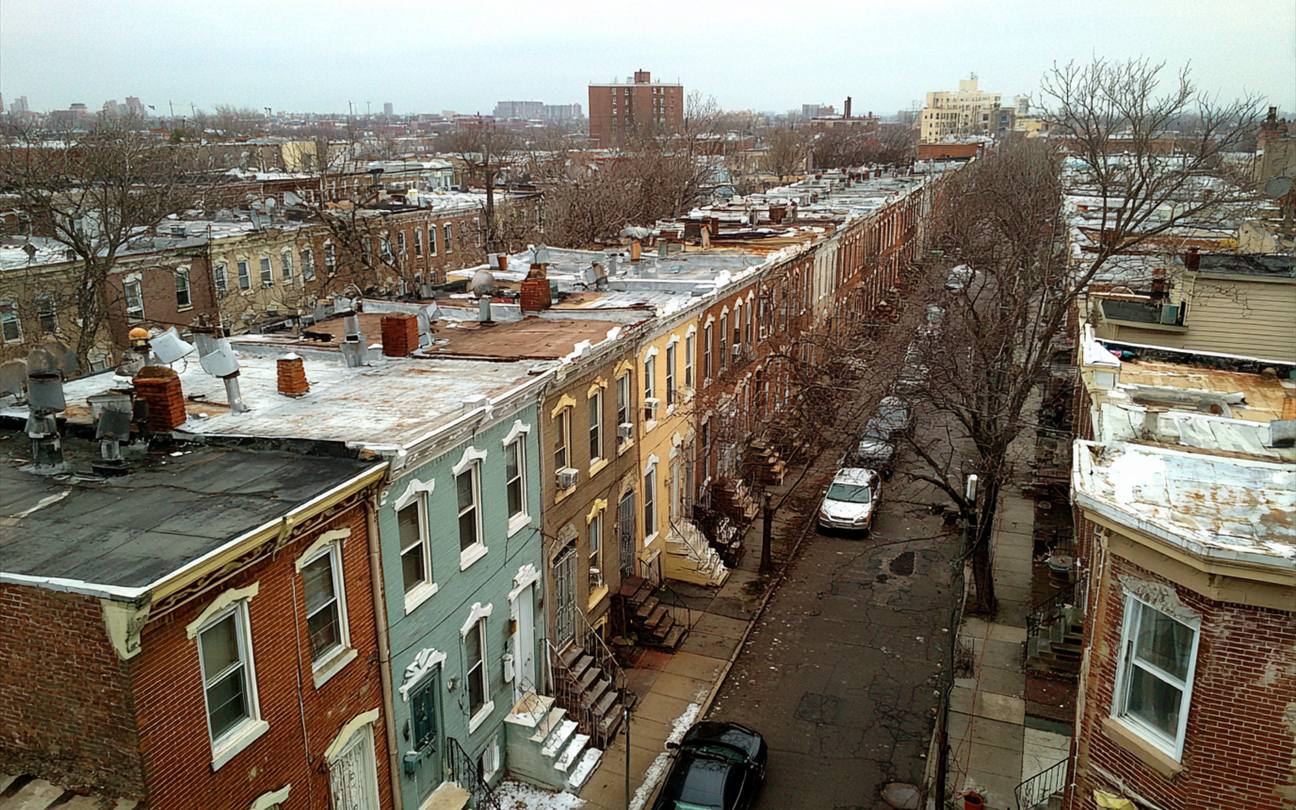
Elizabeth's busy shopping streets are lined with buildings that have a store at street level and apartments above. Up top, most have a flat roof that carries more than rain: exhaust fans from a restaurant, heating and cooling units, vent stacks, sometimes a sign frame or an antenna. Every one of those items sits on or passes through the roof, and every one needs flashing that keeps water out. That's why these roofs leak more often than a plain flat roof of the same age.
What Sits on These Roofs
| Item | How it meets the roof | Where it leaks |
|---|---|---|
| Heating and cooling units | On a raised frame called a curb | The flashing up the sides of the curb |
| Exhaust fans | On curbs, sometimes with grease outlets | Curb flashing; grease can damage some membranes |
| Vent stacks | Pipes through the roof | Boots and collars around the pipe |
| Sign or antenna frames | Bolted to the roof or the parapet | Each bolt hole |
| Parapet walls | Around the roof edge, often decorative at the front | Caps, joints and the decorative cornice |
The Curb Problem
When a unit is replaced, the new one often doesn't match the old curb exactly. A contractor sets it, adapts it, and leaves. If nobody re-flashes the curb into the roof, water gets in at the corners. If your building's equipment was recently swapped and a leak followed, that's the first place to look.
Grease and Membranes
Restaurant exhaust can put grease on the roof around the fan. Some roof membranes break down when grease sits on them. Owners with a restaurant tenant should ask the roofer about grease containment around the fan and a membrane that tolerates it.
The Front Wall
The parapet at the front of many storefront buildings is taller and more decorative than the rest, with a cornice that faces the street. Water that gets into that wall can show up inside the store, often at the front. The cap on top and the joint where the roof turns up the wall are the usual entry points.
Planning Around a Business
- Ask the store's owner or manager for their hours, deliveries and busiest days.
- Plan noisy work for times the store is closed when possible.
- Ask whether swapping rooftop equipment needs a construction permit; the state's rules are run through the NJ Department of Community Affairs.
- Keep the sidewalk clear and safe; the roofer may need to set up barriers.
- Tell upstairs tenants as well. They live under the same roof.
Questions
Who is responsible for rooftop equipment leaks, the roofer or the equipment contractor?
It depends on what failed. If the curb flashing failed, it's usually a roofing fix. If a unit is draining water onto the roof or into its own curb, the equipment contractor may be involved. A roofer can usually tell which it is.
Do commercial and residential flat roofs use the same materials?
Many of the same membranes are used on both. Commercial roofs may need different fire ratings or thicknesses depending on the building.
Can the roof be replaced without closing the store?
Usually, yes. Planning matters more than shutting down.
Around Elizabeth
These buildings are common in Midtown, along shopping streets in Elmora, and in downtown Rahway. Flat roof work is covered on flat roofs.
Ponding Water, Roof Drains and Scuppers on Flat Roofs
Why water sits, where it should go, and what fixes it.
Roof Coating or a New Flat Roof?
When a coating buys real time and when it doesn't.